Content teams are under pressure to use more AI to meet production deadlines. But readers often say they can tell when something is AI-written, due to “AI-isms” or robotic phrasing.
This has led content teams to ask whether AI writing negatively impacts search ranking.
To find out, we analyzed 4,400 blog posts across over 450 keywords using a highly accurate AI detector.
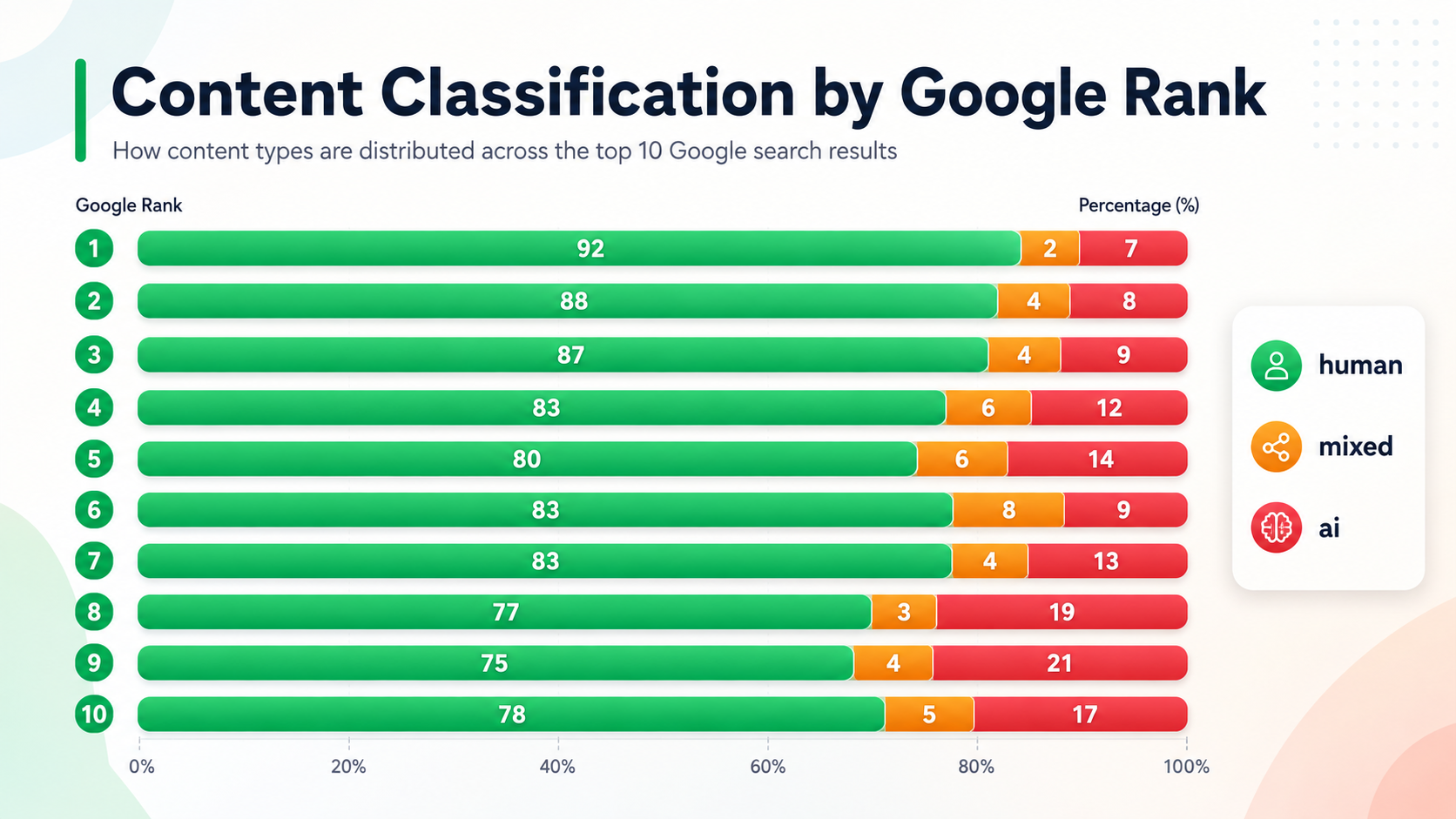
The top spot in Google was occupied by content classified as human-written over 91% of the time. Meanwhile, AI content occupied position #1 for only 6.6% of searches.
This result was consistent across top rankings. Top 3 search results in Google were human-written 89% of the time and AI only 8% of the time. The correlation between AI classification and lower search rank was highly statistically significant.
Moreover, AI writing style had a big impact on search rank. Controlling for article quality, an article being human-written increased the odds of it being in the top 3 results by 62%, while being AI-generated increased by 1.53x the odds of being at ranked 4+.
Key Takeaways
- 91% of top results in Google are human written
- 89% of top 3 search results in Google are classified as human
- Independent of other aspects of article quality (such as EEAT), an article being written in a human style significantly increased the likelihood that it would rank in the top 3
- Google search results show even more preference for human-written content for high volume keywords (≥10,000 per month)
1. Across 4,800 blog posts, the top search results are human-written not AI
After classifying 4,800 blog posts with a highly accurate AI detector, it’s clear that most highly ranked content in Google is human-written.
The differences are strongest at the top. In the rank 1 spot, human-written content appears over 91% of the time and content classified as AI appears only 6.6% of the time. The remaining 1.9% were classified as mixed containing both human and AI content.
For the top 3 search results, 89% of the results were classified as human-written and only 8% were classified as AI.
The majority of clicks go to the top 3 results, so it is striking that almost 90% of the content in the top 3 is human-written.
Even looking to the top 10 – the traditional first page of Google – 82% of these results are human-written and only 13.4% are AI.
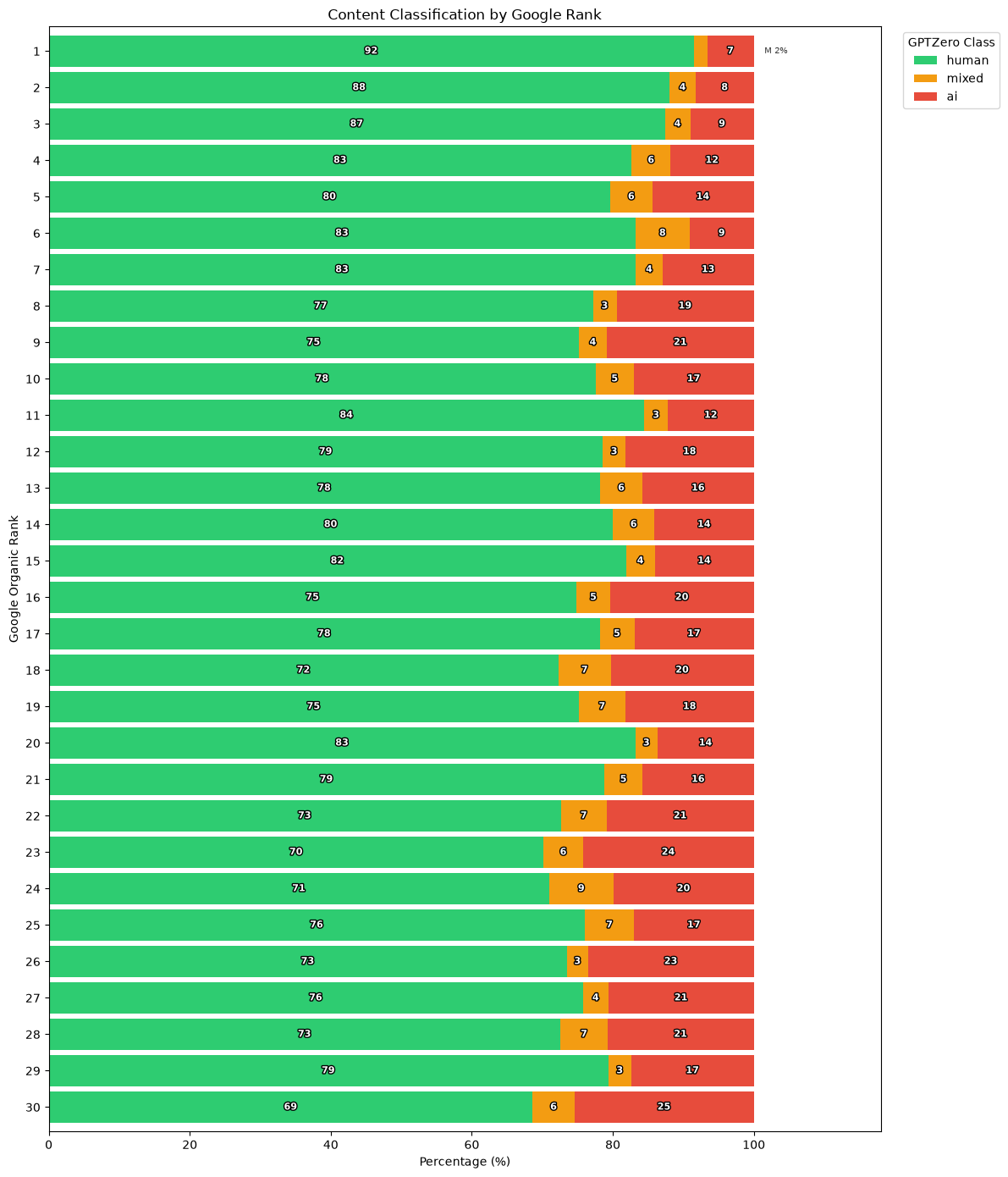
The top 3 and top 10 spots are what most content teams care about. However, looking outside the top 10 can show us the distribution for human and AI articles in Google that would even have a shot at breaking into the first page. On pages 2 and 3 of Google (ranks 10 - 30), the percentage of human-written content is 76% and the percentage of AI content is 18%.
So in real world usage, human content is still much more common in the #1 and also top 3 results of Google, with AI content appearing in one of these spots less than 10% of the time. Even in the top 10 results, AI-generated content is still uncommon (less than 20%).
2. AI content correlates with lower search ranking
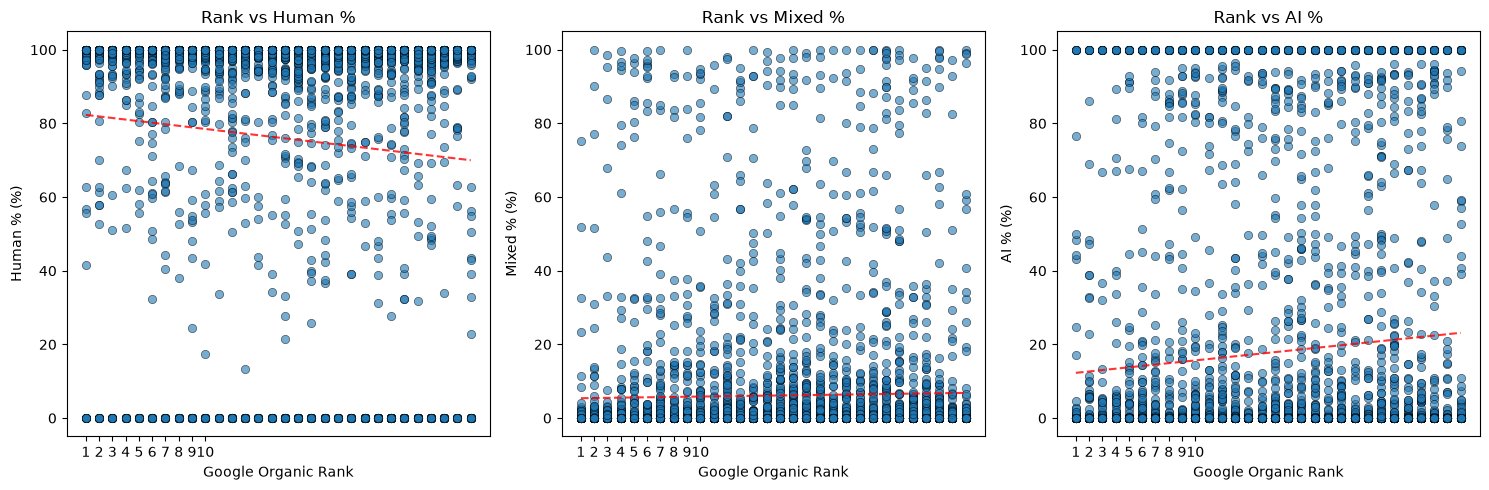
There is a strong correlation between an article being human-written and having a higher Google rank (close to 1) and a strong correlation between an article being classified as AI and having a lower Google rank (farther from 1). Mixed articles were also correlated with a lower Google rank.
All of the correlations reached statistical significance, indicating the patterns found are likely to be true generally and are unlikely to be noise.
3. AI writing style negatively impacts search rank, independent of article quality
Many content teams ask us whether AI writing style negatively affects search results. Does the use of AI-isms and robotic writing cause worse rankings for AI content, or just the fact that AI content might be worse due to quality reasons – such as being less well-researched?
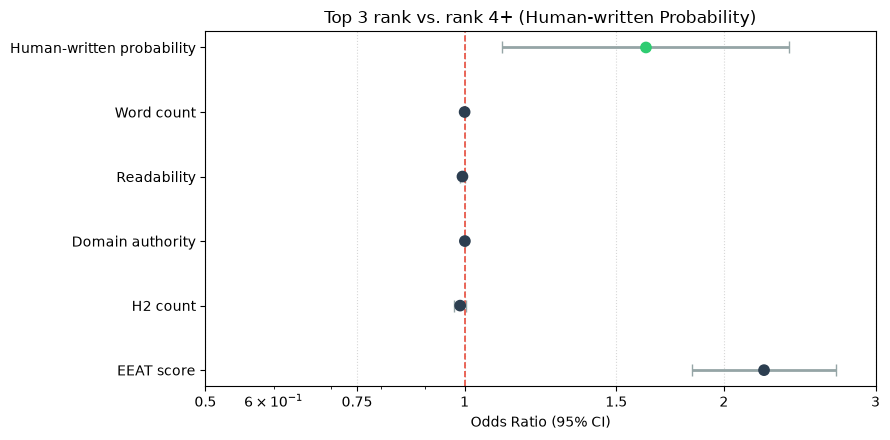
After independently controlling for article quality, an article being human-written increased the odds of it being in the top 3 results by 62%, while an article being AI-generated increased by 1.53x the odds of being ranked 4+. In other words, if the article content was kept the same and only the writing style was changed from AI to human, the odds of being ranked in the top 3 were significantly greater.
Our study controlled for article quality by controlling for article length, writing grade level, domain authority, coverage, and EEAT. The EEAT of each article was graded by a state-of-the-art LLM based on Google’s EEAT rubric and was used as a proxy of overall article quality not captured by other factors .
A higher EEAT score also increased the odds of an article appearing in the top 3 results of Google. This was expected and further validated the results.
Both being human-written and having high article quality as measured by EEAT independently increased the likelihood of an article ranking in the top 3 results.
4. The impact of AI on rank is greater for high-volume keywords
The impact of AI on search ranking was even greater for high volume keywords (monthly volume ≥ 10,000).
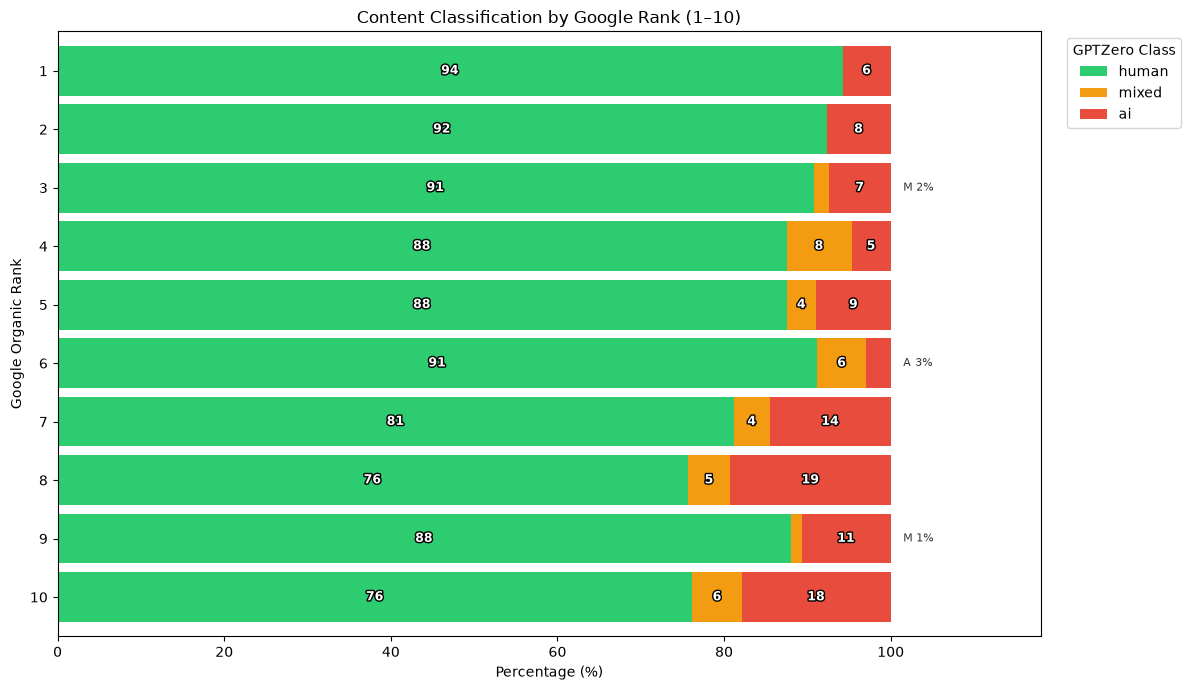
After classifying 2,300 blog results that appeared in high-volume keyword searches, 94% of rank 1 results were classified as human-written, while only 5.8% rank 1 results were AI.
For results in the top 3, 92% were human-written and 7% were AI. This means that there is more human-written content in the top results for high-volume keywords.
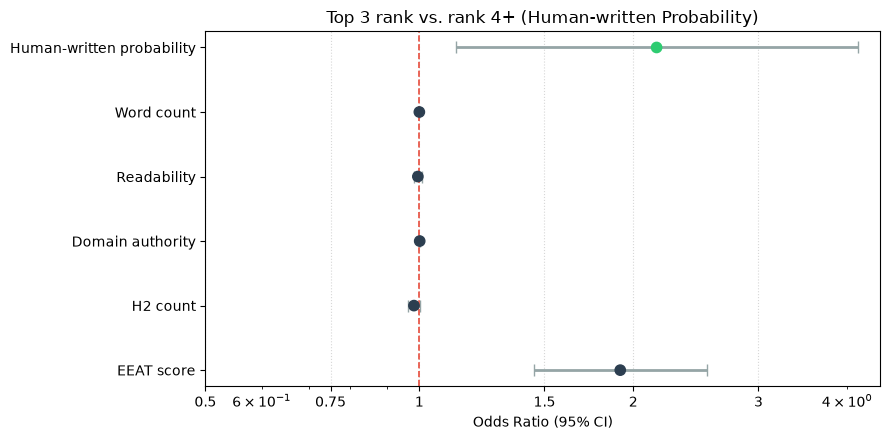
After controlling for article quality, being human-written increased the odds of an article being in the top 3 by 2.1 times. The effect of human writing was even stronger than the effect from adding an additional point to an article’s EEAT score.
For high volume keywords, Google gives even more priority to human-written content.
5. Why does human-written content rank better
While the Google search engine algorithm is a secret to which those outside the company don’t have access, the reason that human-written content ranks higher could be due to two factors.
First, Google has said that its algorithm takes into account user interaction signals to determine whether a page was helpful. The amount of time that a user spends on a page and whether the user clicks on links or interacts with the page are all signals used by Google to determine whether the page was useful for the user’s search.
Human-written content is easier for users to read, which can make it more likely for them to spend more time reading the article and engage with links on the page. This can lead to higher ranking for human-written content even if there is no explicit signal used by Google that the content contains no AI.
Second, AI detection technology is widely available and could be employed by Google at any time as an explicit signal in their ranking algorithm, if they determine that search users are better served by human content. Google already detects and explicitly penalizes domains for things like scaled content abuse and high volumes of low quality pages.
While low volumes of AI usage have not yet been explicitly discouraged by Google, there has recently been a backlash against AI content on other platforms such as LinkedIn and Snapchat and it remains to be seen if Google will follow suit in the future.
6. What this means for content teams
While many content teams are deploying AI, the reality is that most content that is classified as AI-written does not gain a top spot in the Google rankings. This result is statistically significant and still holds when independently controlling for article quality.
Content teams could reject AI and go back to using teams of writers or outsourced agencies, but this may not be realistic given the loss of speed and cost advantages from AI that content teams are expected to utilize.
Other content teams use Vaero, which gives them the ability to use AI that writes like a human. Vaero matches your existing human writing style by training a custom AI model just on your writing, so there are no AI-isms or robotic phrases.
Vaero’s content gets classified as human-written, and teams use it to create articles that get classified in the 89% of human-written articles that occupy the top 3 Google search results.
7. Methodology
The study was conducted from July to August 2, 2026. Over 450 keywords were generated based on SEO data across 20 different topics. The selected keywords had monthly volumes of between 100 and 50,000. The top 30 Google search results extracted for each keyword.
Each page was classified as a blog or not by GPT-5.4. Filtering by “blog” in the url was found to incorrectly miss many blog articles. AI classification was performed using GPTZero, which classified each article as human-written, AI, or mixed, and generated a probability for each classification. Each article was automatically analyzed for characteristics such as writing grade level, domain authority, and coverage. In addition, the articles were scored for EEAT using GPT-5.5, where the LLM based its score on Google’s EEAT guidelines. Google’s EEAT guidelines use a 5-point page quality scale, which was used by the LLM. Statistical analysis was performed with Jupyter.